The whole thing, before you decide whether to read the rest
The problem. The books are weeks behind, the forecast is out of date, and the move on the table is hiring a Head of Finance you do not need yet.
What that hire costs. Three months to find, three to settle, and CHF 150,000 to CHF 180,000 a year cost to the company, whether or not the systems underneath the person exist.
What this is. A sprint of sixty days, adaptable to ninety, that builds the finance function itself: the books, the model, the reporting and the execution work underneath them.
How it works. From the first week I run the finance function myself. Every task the system will take over crosses my desk first.
What you end up with. Books you trust, a current runway date, reporting ready to release, and diligence answered with a link.
What it costs. CHF 15,000 for the sprint, then CHF 3,000 to CHF 4,000 a month to run it, for one Swiss company with books, payroll and payables. Consolidation and multi-entity are added on the second call where the group needs them.
The next step. Thirty minutes, free and without obligation, to find out whether this is your problem at all. If a permanent hire is the right answer, you will hear that too.
You are about to hire a Head of Finance you do not need yet
It is the standard move, and for most founders the wrong one. What the first two years need is not a person in a seat. It is a finance function that exists, and that you can run without becoming a finance person yourself.
Already recruiting? Keep going. Run this alongside the search, and the person you hire inherits a function that works instead of spending six months building one.
- Bookkeeping three weeks behind, so every decision is made on a feeling.
- A forecast that is always out of date. One spreadsheet, one person who understands it, never properly rebased on what happened. The runway date it shows is the number you trust least.
- No way to see what a hire or a big spend does to that date before you commit to it.
- Investor reporting rebuilt by hand every quarter, late, and never the same twice.
- Two or three entities that should consolidate and do not, so nobody can say what the group made.
Underneath sits a second worry: if I hand this over, do I still understand my own company, and can I stand behind the numbers I sign? A fair question. A finance function you cannot see into is worse than a late one.
A sprint that leaves a finance function behind
Sixty days, adaptable to ninety when the group is more complicated. At the end the finance function runs on a cadence you set, documented for the person you eventually hire.
5 things you end up with
- You know where you stand whenever you look. The position as it is today, not a report on a month that has gone.
- You know how long the money lasts, this month. The plan is rebased on what actually happened, so a hire or a delay is a decision you take rather than one you discover.
- You can say yes to a diligence request on the day it arrives. Answering is sending a link.
- Three days after the close, the reporting is waiting for you. Your part is the judgement. The assembling is done.
- You can ask your own numbers a question and get the source with the answer. No figure is one you have to take on trust.
The sprint is CHF 15,000, fixed and agreed in writing before anything starts. Four parts, the same four as in the contract. The first three sit inside the setup fee, the fourth is the monthly run:
- Setup. Sixty days of build, ninety where the group starts from nothing. During the sprint I run the finance function myself and build each task into the system as I do it. You hand your process to the person who will run it and then automate it. CHF 15,000 fixed for the sixty-day sprint; where it runs to ninety, the price is agreed and written down on the second call, before anything starts.
- Training. Three sessions of two hours for your team, inside the setup fee, given by the person who built it.
- Check-ins. Also inside the setup fee. Fortnightly for the first three months after go-live, monthly for three more, then on request. A problem can be reported at any time and is fixed within 36 hours.
- The run. On top of the setup fee: CHF 3,000 to CHF 4,000 per month for the system, the reporting cycle and continued access to me.
Before the sprint starts we write down what working means, as a concrete acceptance test. Anything that does not pass it, I do by hand, at the same price, until it does. If at the end it still does not stand, you get the kick-off half back, CHF 7,500 on the sixty-day sprint, and the second half is never invoiced, so the sprint costs you nothing.
How it is paid
- Half at kick-off, when the scope of work is signed.
- Half at handover, and only when it passes the acceptance test we wrote together. Not on a date, on the test.
- The monthly starts after that, once the function is deployed, accepted and running on its own. What role I keep after that is yours to decide, and we write it down if you want one.
What the monthly actually buys
- It keeps getting better. Every correction you make becomes a rule, so a thing fixed once does not come back. That is why there is a monthly fee rather than a licence.
- Everything is checked before you see it. Key figures are re-derived by a second, independent route, and where it matters by a different model as well.
- A log of everything, kept. Every step, source and change is recorded, so any figure can be walked backwards months later, by you or by a diligence team.
On the sixty-day sprint the first year is CHF 45,000 to CHF 55,000 in total: CHF 15,000 for the sprint, then CHF 3,000 to CHF 4,000 a month for the ten months after it. From the second year it is CHF 36,000 to CHF 48,000 a year, and the systems exist either way. Put that next to the offer letter you were about to sign: a CFO on your payroll is CHF 150,000 to CHF 180,000 a year, cost to the company with employer social charges in it.
The books, current and trusted
Bookkeeping caught up, carried by us inside the system, which is where the three-week delay stops. One Swiss company in the standard sprint; multi-entity and consolidation are added on the second call where the group needs them. A month end without a fire drill, and a close that refuses a figure it cannot reconcile rather than carrying it forward.
A model that survives being pulled on
Operations tied to cash, not a revenue curve with a margin under it. Rebased on the actuals every month, so the runway date moves when reality does. Every number traceable to its entry, built to hold when an investor pushes on it.
Reporting you approve, not reporting you assemble
The board pack and the investor update arrive drafted from the books, in the same shape every quarter, on time. You change what you want and release it. What you change is learned, so the next one is closer to how you would have written it.
The system is modular, and the sprint is not the only way in. A module can be ordered on its own, or two or three in sequence. Starting with one is often sensible: you see how I work and how the system behaves on one part of your finance function. When you are satisfied, you take the next. If not, you carry on as today, and you have lost a module rather than a year.
- A first call. Thirty minutes, free and without obligation, to see whether this is your problem at all. Sometimes the answer is the hire, and I will say so.
- Scope on the second call, with the sequence and the cost written down.
- The sprint. Sixty days, adaptable to ninety, in working sessions, built around how your company actually works.
- Handover. Documented, and the reporting cycle runs on its own. What role I keep is yours to choose.
The whole finance function, not the parts that demo well
Everything here is inside the sprint for a single Swiss company, except where a line says otherwise.
Books, close and execution
- Bank data pulled where there is a feed and read off the statements where there is not, because several Swiss banks still have no usable one.
- Transactions booked and classified on your own history. Where it is unsure it asks, and it remembers your answer.
- A close finished by working day three: accruals, prepayments, revenue recognition, inventory where you hold it, bank reconciliations, and an exception queue rather than a silent guess.
- The execution work as well. Payment files for your bank created automatically from the approved payables, payroll and social insurance, payables, and one cash view across every account and currency.
- Consolidation across subsidiaries, intercompany eliminated, monthly, where the group needs it. That is the ninety-day sprint, scoped and priced on the second call.
- Money never moves by itself. Payments are prepared; you approve and release every one.
Steering, forecasting and reporting
- Variance analysis, both of them. Actuals against the approved budget, and against the last rebased forecast: whether you are on the plan you sold, and on the plan you now believe.
- The model rebased on real actuals every month, so the runway date is current.
- Scenario analysis. Ask in plain language what two sales hires in October do, or a delayed tranche, or a price change, and get the effect on runway, burn and payback on your own numbers, before you commit.
- Board pack and investor update drafted from the books in minutes, edited by chat, filed automatically. With the feedback loop closed: what the board asked last time is answered in the next one.
- A data room kept current, so diligence starts on the day you are asked.
- The Watchdog, running every day on overspend, budget overruns and anomalies in the daily numbers. The message goes straight to the person responsible, earlier than a monthly report would show it.
Talk to your finances
Chat with your automated CFO. It knows your numbers, your KPIs and your strategy, and it is available at any hour. Ask in plain language, in Slack, by email or in the system itself, and get the answer with the figures behind it and the source of each one. Alerts arrive the same way. Where it cannot ground an answer, it says so.
Always calculated, never guessed. The AI moves, classifies and explains. It does not do the arithmetic. Every figure comes from a deterministic formula in the spreadsheet, traceable to the ledger entry underneath it.
And it is fast, which is the part that changes behaviour
The close lands on working day three rather than three weeks later, and between closes the numbers are close to real time. The limit is Swiss banking: where a bank has no feed, the last mile is a file, and we tell you which of your accounts are which before you buy anything.
A number that arrives three weeks late is a report. A number on day three is still a decision you can make.
You have a CFO from day one, not at the end of it
From the first week I run the finance function myself while it is being built: the board pack goes out, the payments get prepared, the questions get answered. Every task the system is going to take over crosses my desk first and is handled by me.
A forward deployed CFO
I work inside the company rather than reporting on it from outside, the way a forward deployed engineer sits with the customer until the software fits the work.
The workflows get captured while they run
Every procedure that touches finance is mapped while a finance person does it, the only time it is accurate, not described to a developer afterwards. The system is built from that capture, and your eventual hire inherits it as documentation.
Your model, improved or rebuilt, whichever suits
Your budget and model can be improved and become the basis of the system, or we build a new one together during the sprint. Which is right is usually clear within a week. Modelling is what I do best, so I would rather build it with you than hand you a template.
The finance function on a screen, before you commit to anything
The working demo opens inside this page. It runs on two invented companies, Alpina Bio AG in Basel and Meridian Robotics GmbH in Munich, because no client's numbers belong on a public website. The mechanics are the real ones: one calculation engine, typed fixtures, nothing in the interface hardcoded.
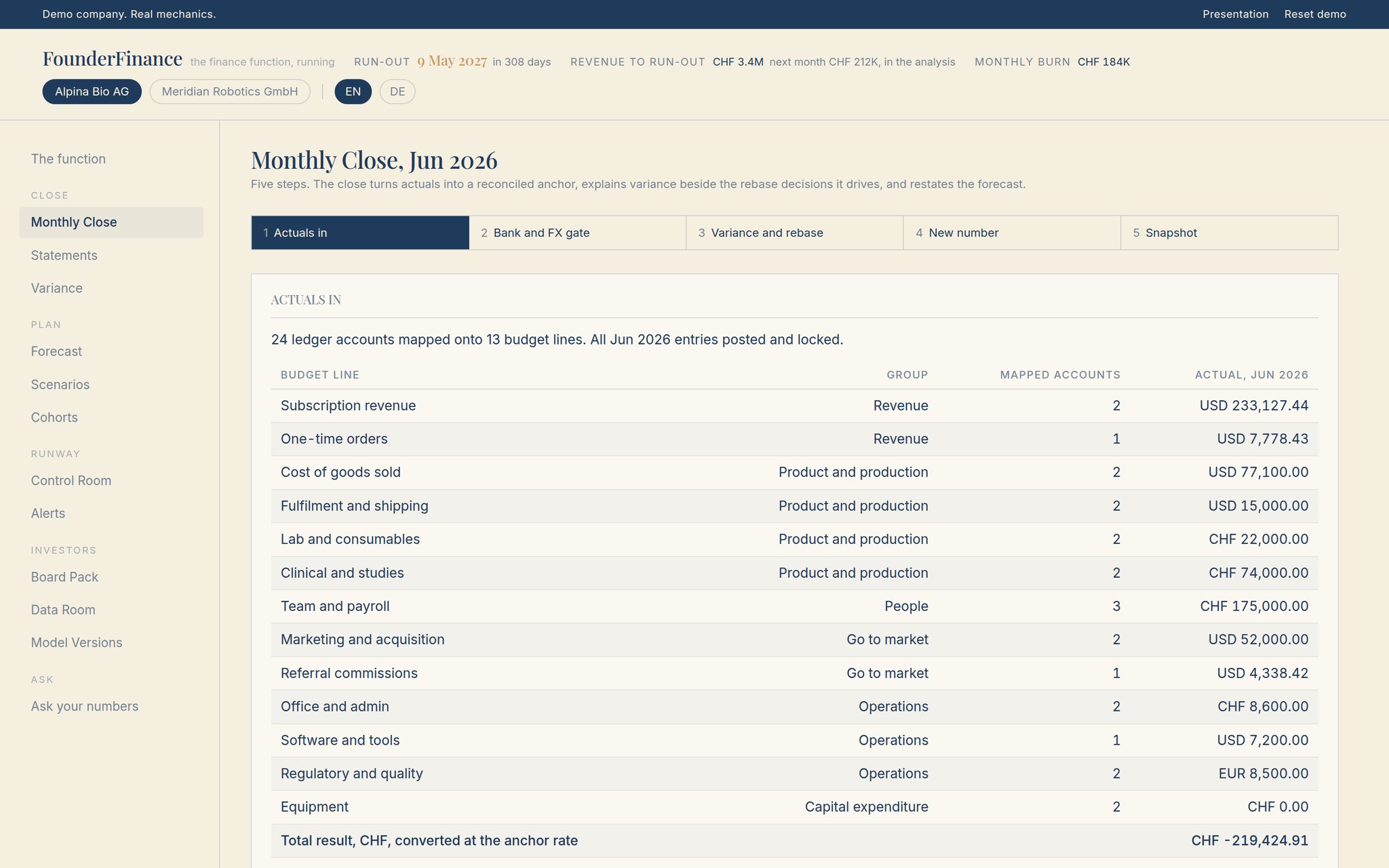
It opens on the monthly close, where trust is earned or lost. The left-hand column walks the rest: the rebase, the scenarios, the board pack, the data room. Every figure carries its own currency code. Prefer a full window? Open the demo in a new tab.
Or watch it walked through, out loud
Four minutes and fifty-three seconds, on the same invented companies: the close and the bank and FX gate, the rebase, a scenario priced while the decision is still open, and what the run-out date does when the answer lands. Nothing is requested from Loom until you press play.

Prefer a full window, with the chapter list and the transcript? Watch it on Loom in a new tab.
And it is adapted to you. The screens, the reports, the cadence and the language are shaped around how your company runs, during the sprint, with you in the room. If the board pack in your head looks nothing like the demo's, yours is the version you get.
The decision layer. Somebody else already sells the compliance layer.
Bookkeeping, VAT returns and annual accounts are a solved and cheap market in Switzerland, and not ours. What almost nobody sells a founder is the layer above: the number you steer on, why it moved, and what the decision you are considering does to it.
What we do
Forecast and rolling model, the monthly close and the rebase that follows it, scenario testing, runway, variance against budget and against the last rebase, board and investor reporting, the data room, and the execution work underneath all of it. The bookkeeping comes inside the system, and that is deliberate. Bookkeeping outside is where the delay comes from: you wait for someone else's month before you can look at your own. We carry the books and the VAT returns ourselves, as we do for our own company and for another Swiss firm.
What we do not do
Not your annual accounts and not your audit: your Treuhand stays, and the year end stays with them or with your auditor. Not legal or tax opinions. Not a cheap self-serve tier, because at that price the work stops being senior and stops being a CFO.
Two more limits. The system prepares and a person releases, so nothing goes out in your name without you seeing it, and where it cannot ground a figure in something traceable it stops and asks. And it is not live to the minute: the acceptance test promises a close finished by working day three, once the bank and Treuhand inputs are in, because not every Swiss bank offers a usable feed yet.
An entrepreneur who has built the function, not an adviser who has seen one
- Companies built and carried personally, one recently sold, and still on the board of another. The finance function built from nothing three times, most recently as the sole finance leader at KetoSwiss, a venture-capital funded Swiss life-sciences startup, October 2023 to April 2026, leading a completed CHF 3.5m round end to end, with payroll, social insurance, contracts and hiring.
- Your sector is probably already on this list: physical goods and subscription businesses, capital-intensive assets and real estate, R&D-heavy companies, international trade and food processing. If yours is not, the machine that turns money into output looks much the same.
- Not a software engineer and no Fachausweis, and you should know that now. What you get is the finance function and the systems under it, from me, having run one with my own money behind it.

I am an entrepreneur before I am a finance person. I have built companies and carried them, built the teams inside them, and built the processes from nothing rather than inheriting them. Then I signed for the numbers those processes produced. What is unusual is not any one of those, it is the combination: an owner-operator, twenty years of finance under it, and a working, current command of agentic AI. All of it points at one thing, which is more value created in your company.
- An entrepreneur first. Companies built and carried personally, one recently sold, and still on the board of another.
- Twenty years in finance, nine as a CFO and owner-operator, with the finance function built from nothing three times rather than inherited.
- The sole finance leader at KetoSwiss, a venture-capital funded Swiss life-sciences startup, leading a completed CHF 3.5m financing round end to end.
- Investment and forecasting at a Swiss asset manager, with CHF 6.5m saved on a co-led CHF 200m+ development.
Built inside physical goods and subscription businesses, capital-intensive assets and real estate, R&D-heavy companies, international trade and food processing. We build custom, for one company at a time, in the sectors we actually know.
What I am not: a software engineer, and I do not hold a Fachausweis. I am experienced with AI and with corporate finance. If a Fachausweis is a must-have for you, I am not the right person, and I would rather you knew that now than after a call.
Questions we get asked
Is this instead of hiring a CFO or a Head of Finance?
It is instead of hiring one yet. The sprint builds the finance function first, so the person you eventually hire inherits working books, a live model and a reporting cycle that runs, rather than spending six months building them. Sometimes the honest answer on the first call is that you should hire now, and then I will say so and tell you what to look for.
What does it cost?
The sixty day sprint is CHF 15,000, half at kick-off when the scope of work is signed and half at handover, once the acceptance test we wrote together has passed. Running it afterwards is CHF 3,000 to CHF 4,000 per month for the system, the reporting cycle and continued access to me, starting only once the function is accepted and running on its own. Three training sessions of two hours are included. Where a group starts from nothing the sprint runs to ninety days; the price is agreed and written down on the second call, before anything starts.
What is the guarantee?
Before the sprint starts we write down what working means, as a concrete acceptance test agreed by both of us. Anything that does not pass it, I do by hand, at the same price, until it does, so you have a working finance function from day one. If at the end it still does not stand, you get the kick-off half back and the second half is never invoiced, so the sprint costs you nothing. An unbounded guarantee is worth nothing, so we bound it in the contract instead.
If a system is doing the work, what is left for me?
The deciding, which was always the part worth your time. The system learns your company from every correction you make, so it gets more like you over time. It prepares and you release. Where it cannot ground a number in something traceable it stops and asks. It does not replace you. It represents you, so that you are not in every loop.
Do you replace our Treuhand?
No. Your Treuhand stays, with the annual accounts and the audit. The bookkeeping and the VAT returns we carry inside the system, as we already do for our own company and for another Swiss firm, so your numbers arrive current instead of three weeks late as a PDF.
How is this different from the digital bookkeeping tools?
Different layer. Those sell the compliance layer, bookkeeping, VAT and year end, at a price that only works with thousands of clients, and they are good value for exactly that. None of it tells you when you run out of money, what moved the number since last month, or what a hire in October does to the runway. That is the layer we build. If a tool is the only finance you have today, keep it and add this on top.
Can we see it before we buy it?
Yes. The working demo opens on this page, on two invented companies, with no login and nothing to install. On the call we walk through it against your situation, which is a more useful half hour than any deck.
Which sectors do you work with?
Sector-agnostic on purpose. The machine that turns money into output looks the same whether it is making furniture, software or protein. What matters more is whether your cost base has outgrown what you can hold in your head, and whether finance is somebody's actual job yet.
What happens after the sprint ends?
The function runs, and you work with it however suits you: it sends you the alerts and you ask it questions the way you would ask a CFO. The system itself stays ours and we keep it running and learning your company: that is what the monthly fee is for. Your data, your documentation and your numbers are yours throughout, and if you ever stop you leave with them and your model files. For anything the system cannot help you with, I am still there: fortnightly check-ins for the first three months after go-live, monthly for three more, then on request, with any problem fixed within 36 hours.
Can you consolidate our subsidiaries?
Yes, as an add-on to the standard sprint, scoped and priced on the second call. A standard bookkeeping tool does not consolidate; a Treuhand will, with a delay you feel every time you need the group picture. Here the group view comes monthly with the rest of the close, intercompany eliminated, in the same shape every time. Multi-currency comes with it, and every figure carries its own currency code.
Can you show me a reference?
References on request. Ask on the call and you will be given names and numbers to ring. Client names and figures are not published without written permission, the same discipline that would apply to yours.
Something not answered here? Ask it on the call, or ring +41 44 798 55 85.
Thirty minutes to find out if this is your problem
No preparation and no pitch deck. Everything is built in modules and shaped around you: it does not have to be all of it, and it can include other things. If a permanent hire is the right answer, I will tell you what to look for.
Pick a slot in the calendarThirty minutes, free and without obligation. If the hire is the right answer, you will hear that too.
If none of those slots suit you, tell me when and I will work around it.
Or ring +41 44 798 55 85. References on request.